Facing the Okapi
Theologian Thandi Soko-De Jong was born and raised in Malawi, where she first encountered Christian missionaries. She found these missionaries to be a peculiar group of people, but only understood her discomfort when she had read The Poisonwood Bible during her studies. Years later she returns to the novel to investigate the relation between mission and colonialisation and to reflect on the question how ‘the good news’ can be shared in a good way.
“We aimed for no more than to have dominion over every creature that moved upon the earth. And so it came to pass that we stepped down there on a place we believed unformed, where only darkness moved on the face of the waters.”
– Barbara Kingsolver
Meeting Missionaries
I was born and mostly raised in Malawi. But my first real brush with the idea of ‘missions’ came in Manzini, Eswatini, where as a child I attended a so-called international church. Families from the Netherlands, Canada, and the United States would pass through, contracted to work at a Christian outreach radio station near Manzini. While they were there, they would join the church, even though, as I vaguely recall, it was not their usual denomination back home. This particular church simply felt closest to non-denominational, since it had no local pastor of its own. Instead, missionaries and church elders alternated in leading the services on the Sundays when a denominational pastor was not required to visit and handle the sacraments.
As a child, I found the missionaries I encountered an unusual group of people. They mostly kept to themselves during their free time. I do not know if it was just because I encountered them as a child and therefore the depth of their conversations with me was limited, but I remember that we rarely strayed into anything deeper than small talk. Much of their chatter revolved around the regular potluck nights at church, especially the foods they missed and hoped to introduce to African members. They also seemed preoccupied in conversation with the cultural differences they observed and the recorded sports games they watched on videotapes. One of them even admitted he had been scared to come to the continent of Africa at all and had only done so out of self-sacrifice and obedience to God’s calling. He had been scared that Africans would cook him in a pot upon seeing him. Coming from an adult, it was a startling and confusing thing to hear.
Once I overheard a candid conversation they were having among themselves. It was about eternal security. I understood enough then to know that one of them was wrestling with the doctrine. But beyond that, their ‘mission’ never felt like it had much to do with me or anyone I knew. They seemed to be searching for an elusive group of people who were ‘unreached’ and were therefore always planning bigger and better strategies to ‘reach’ them.
The Poisonwood Bible
Years later, as I trained as a theologian, I stumbled upon Barbara Kingsolver’s The Poisonwood Bible (1998, De gifhouten bijbel) – ironically in a Malawian Christian bookshop better known for devotionals and theology books. Kingsolver’s book tells the story of a missionary who, in the 1950s, takes his wife and four daughters from the US to Belgium-colonised Congo, where they watch their lives unravel as they confront the reality of colonialism. Although it is a work of fiction, it ended up teaching me more about missions than anything I might have picked up on one of my usual visits there.
The impact of this novel on my understanding of missions will become more evident as this series of reflections progresses. Having lived in and visited several traditional mission-sending countries, including the Netherlands, and drawing on my academic research into theologies of liberation, I would like to invite us, in this article, to revisit Kingsolver’s book and consider the lessons it may still offer 70 years after the setting of the book’s story.
But first, who is Barbara Kingsolver?
Barbara Kingsolver (b. 1955) is an American novelist, essayist, and poet. The seed for The Poisonwood Bible was planted during her childhood in what is now the Democratic Republic of the Congo (DRC), where her parents worked as health workers. While that experience left an indelible mark on the novel, the book is neither a memoir nor a nostalgic fictional depiction; instead, it is an act of observing and questioning. And that is precisely what makes it such a rich source for my own reflections on missionary work. This is my contribution to the conversation on missions and decoloniality. Much has been written from the theological perspective of Western missionaries reflecting on their experiences in the Majority World; far less has been written from the reverse perspective. In this article I will provide the viewpoint of a Malawian who has encountered missionaries within both African and Western contexts.
The Drear Picnic
The Poisonwood Bible begins, like the Bible, in Genesis. “And God said unto them: “‘Be fruitful, and multiply, and replenish the earth, and subdue it: and have dominion over the fowl of the air, and over every living thing that moveth upon the earth.’” (Genesis 1:28, King James Version) This is the first passage brought to your attention. With dominion established as the opening theme, we are introduced first to Orleanna Price, spouse of missionary Nathan Price and mother to their four daughters. The book’s opening scenes, a dreary picnic, are narrated in her voice.
Orleanna first invites us to “picture the forest”. A violent and unforgiving forest, where vines strangle “their own kin”, and “a single file of an army of ants biting a mammoth tree… and hauling it down to the dark for their ravenous queen”. We are asked, “to be its conscience, the eyes in the trees”.
Then, she draws our attention to another “single file”. This time, it consists of a woman leading four daughters; “all of them in shirtwaist dresses”. Seeing them “from above this way”, we are likely to appeal to our sympathies. However, we are cautioned against our uncritical sympathy; we must wait a while to decide “what sympathy they deserve”.
The mother “sets out their drear picnic” at the stream’s bank. After silently eating the bland food, the girls go for a swim. The mother is left alone; “unhumanly alone” resting “uneasily in the silence”. But then we read that all at once she is no longer alone. “A beautiful animal stands on the other side of the water”. They look up from their lives, woman and animal, amazed to find themselves in the same place.
“A Unicorn that Could Look You in the Eye”
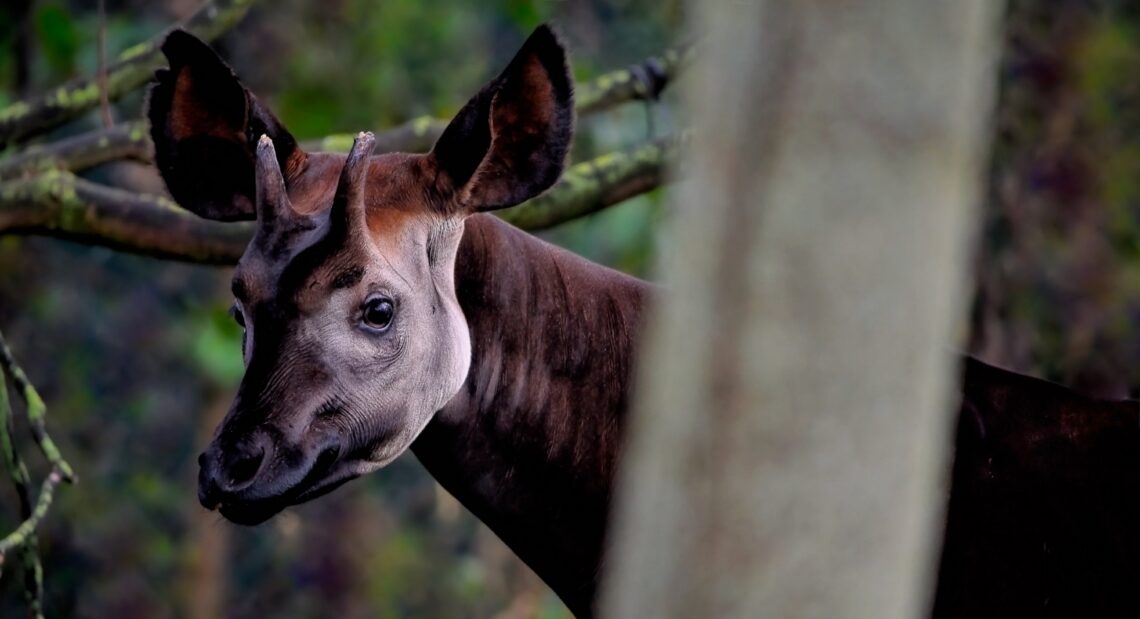
The beautiful animal Orleanna is referring to is the okapi, an elusive mammal that resides deep within the rainforests of the Congo. Okapis, until the 1920s, were an unrecognised species in the West. This was despite accounts by Congolese communities attesting to their existence. The okapi in Orleanna’s narration, particularly its cryptid status in the West, functions as a symbol of the erasure that results from colonial and patriarchal knowledge systems.
Orleanna encounters the okapi in the forest, and they both stop to stare at each other. The moment is significant because although the okapi had by this point been recognised in the West, this is a scene in which Orleanna, as a Western woman, symbolically counters the erasure resulting from the colonial and patriarchal knowledge systems; systems that exclude women and non-Western peoples as credible knowers.
Encountering the okapi and recounting her experiences in the Congo, Orleanna recognises that, like many missionaries, she was complicit in the colonisation of Africans because the methods of mission work on which they relied depended on conformity to colonialism. She asks herself, “What would Africa be now?” And she responds, “All I can think of is the other okapi, the one they used to believe in. A unicorn that could look you in the eye.”
She takes some accountability, yet she also insists on being seen as a woman who was herself dominated by patriarchal norms. Gesturing toward the tragedies that will unfold later in the novel, she confesses:
I would be no different from the next one, if I hadn’t paid my own little part in blood. I trod on Africa without a thought, straight from our family’s divinely inspired beginning to our terrible end.
And yet she resists shouldering the blame alone, asking:
What is the conqueror’s wife, if not a conquest herself? For that matter, what is he? When he rides in to vanquish the untouched tribes [sic].
She adds simply, “I didn’t know. I had no life of my own”, but quickly complicates this admission by calling attention to her social locus as a woman shaped by Victorian ideals of feminine piety, ideals that led her to accept a self-effacing, sacrificial role as wife. Notably, these ideals cast men as the main family providers, but conveniently ignored a big question: where exactly was that support supposed to come from? During the colonial era, missionaries, just like all other colonial agents, soldiers, and merchants, funded their households using the spoils of colonial conquest. In this light, Orleanna’s family dynamic is not an exception to the rule but a perfect example of it. Orleanna adds:
I married a man who could never love me, probably. It would have trespassed on his devotion to all mankind [sic]. I remained his wife because it was one thing I was able to do each day.
But she senses, too, that this is not defence enough. She turns to address the reader directly, anticipating their judgement:
And you’ll say I did [know]. You’ll say I walked across Africa with my wrists unshackled, and now I am one more soul walking free in a white skin, wearing some thread of the stolen goods: cotton or diamonds, freedom at the very least, prosperity.
Some of us know how we came by our fortune, and some of us don’t, but we wear it all the same. There’s only one question worth asking now: how do we aim to live with it?
Reflections: Turning Back the Gaze
Orleana concludes that, like the unrecognised okapi, an unconquered Africa would readily meet a conqueror’s gaze. The quotations discussed above indicate a clear shift in her perspective. Her experiences led her to realise that her outward gaze on the ‘mission field’ has always been returned through the people, nature, and broader reality around her. This prompted a more direct and self-reflective confrontation with her own position.
Thus, rather than maintaining that outward gaze, Orleanna suggests turning it upon herself by going beyond the question of whether she could have known. In doing so, self-scrutiny becomes a genuine site of reckoning with one’s mission theology. This is part of the work of decoloniality: taking stock of what colonisation has done, where one has been complicit, and recognising how one might contribute to repair. For Orleanna, that process begins with acknowledging the consequences of the theological ideas she and her family carried with them, ideas that centred dominion without questioning its assumptions. As she reflects:
Now you laugh, day and night, while you gnaw on my bones. But what else could we have thought? Only that it began and ended with us. What do we know, even now? Ask the children. Look at what they grew up to be. We can only speak of the things we carried with us, and the things we took away.
If Christian missionaries are meant to proclaim the good news, then we must ask: How did dominion become its good news? And what might truly good news look like when it is freed from the logic of dominion?
The rest of this series will explore the novel for themes that help us turn the gaze back on the enduring consequences of the dominion theologies that have underpinned many missionary stories. These consequences include theological frameworks that have legitimised ongoing issues like environmental exploitation, entrenched economic and social inequalities, and shaped enduring assumptions about power, the earth, and a shared humanity.
Hier kan je de Nederlandse versie van het artikel lezen

Thandi Soko-de Jong is co-moderator van de gender justice reference group van de Wereldraad van Kerken.